
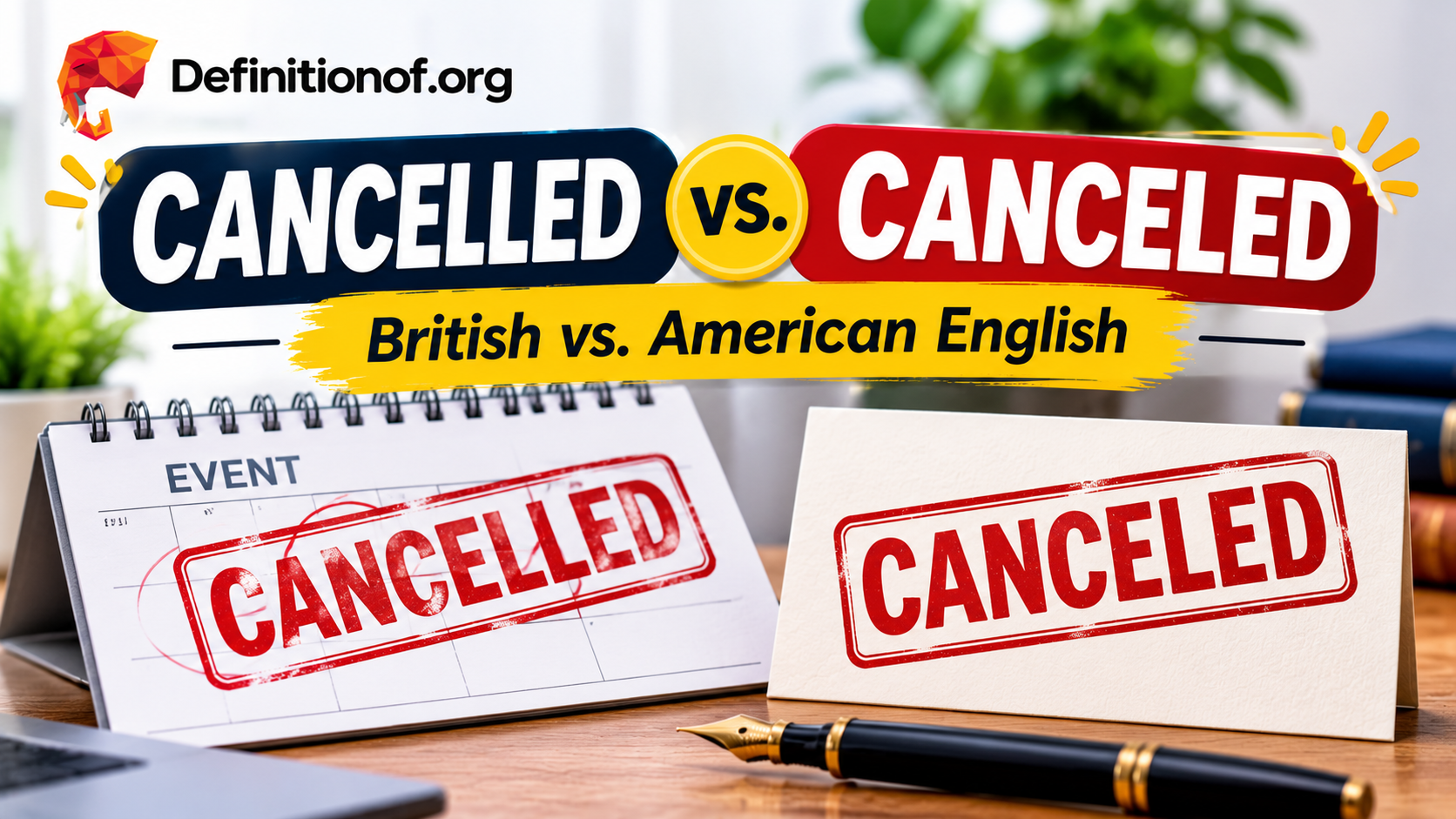
Cancelled vs. Canceled: Spelling, Usage, and Confusing Words
Both “cancelled” and “canceled” are correct spellings. The difference depends on the variety of English you use. British English, Australian English, and many other English varieties generally use cancelled with two Ls. American English generally uses canceled with one L.
Both spellings are the past tense and past participle of the verb cancel. They mean that a planned event, appointment, service, order, or activity has been called off.
Examples:
- The school cancelled the outdoor event because of heavy rain. (British English)
- The airline canceled the flight because of bad weather. (American English)
- Our meeting was cancelled at the last minute.
- The company canceled the order before it was shipped.
The pronunciation and meaning do not change. Only the spelling differs.
British vs. American English
The main difference between British and American English is the number of Ls used in the past tense of cancel.
| Word form | British English | American English |
|---|---|---|
| Past tense | cancelled | canceled |
| Present participle | cancelling | canceling |
| Noun | cancellation | cancellation |
| Person or thing that cancels | canceller | canceler |
British English generally doubles the final L when adding endings such as -ed and -ing. American English usually keeps one L in canceled and canceling.
British English examples
- The concert was cancelled because the singer was ill.
- The manager is cancelling tomorrow’s appointment.
- The train service was cancelled without prior notice.
American English examples
- The concert was canceled because the singer was sick.
- The manager is canceling tomorrow’s appointment.
- The train service was canceled without prior notice.
Which spelling should international writers use?
Choose the spelling that matches your intended audience. Use cancelled when following British English conventions and canceled when following American English conventions. For international websites, consistency across the article and the wider website matters more than choosing one regional form.
Tips to Remember the Difference
Use these four tips to choose the correct spelling:
- Remember the region: British English generally uses cancelled, while American English generally uses canceled.
- Check the related verb form: British English uses cancelling; American English usually uses canceling.
- Keep the noun consistent: Use cancellation with two Ls in both varieties of English.
- Follow one style: Do not switch between canceled and cancelled within the same document unless you are quoting a source.
A quick memory aid is to associate the longer spelling, cancelled, with British English and the shorter spelling, canceled, with American English.
Exception
The noun cancellation is normally spelled with two Ls in both British and American English.
Examples:
- The cancellation of the flight caused delays for hundreds of passengers.
- We received a confirmation email about the cancellation of our booking.
- The event organizer announced the cancellation of the festival.
The spelling cancelation with one L does appear in some American usage, but cancellation is the standard and much more widely used form. Use cancellation in formal writing and general communication.
Commonly Confused
English contains many words that look or sound similar but have different meanings. Correct spelling and context help readers understand the intended message.
What’s the difference between ‘fascism’ and ‘socialism’?
Fascism and socialism are different political ideologies. Fascism is an authoritarian political ideology associated with dictatorial leadership, extreme nationalism, and the suppression of political opposition. Socialism is a political and economic tradition that supports social or public ownership, control, or regulation of important resources and industries, with the aim of reducing economic inequality.
The terms are not interchangeable:
- Fascism is often associated with authoritarian rule and ultranationalism.
- Socialism focuses on social ownership or control and the distribution of economic resources.
The meaning of each term depends on its historical and political context.
7 Pairs of Commonly Confused Words
These seven pairs have different meanings and grammatical uses:
| Word pair | Difference | Example |
|---|---|---|
| Accept / Except | Accept means to receive; except means excluding. | I accept every option except the last one. |
| Affect / Effect | Affect is usually a verb; effect is usually a noun. | The weather can affect the result. |
| Advice / Advise | Advice is a noun; advise is a verb. | My teacher gave me useful advice. |
| Compliment / Complement | A compliment is praise; a complement completes or goes well with something. | The blue tie complements his shirt. |
| Principal / Principle | A principal can be a school leader or a main person or thing; a principle is a rule or belief. | Honesty is an important principle. |
| Stationary / Stationery | Stationary means not moving; stationery means writing materials. | The car remained stationary near the stationery shop. |
| Then / Than | Then refers to time or sequence; than makes a comparison. | She arrived earlier than I did. |
‘Capitol’ or ‘Capital’?
Capital and capitol have different meanings.
- Capital: A city that serves as the seat of government, money used for investment, or an uppercase letter.
- Capitol: A building where a legislative body meets, especially the United States Capitol.
Examples:
- New Delhi is the capital of India.
- The US Congress meets in the Capitol in Washington, D.C.
- The company needs more capital to expand its business.
‘Demur’ and ‘Demure’: Not to be Confused
Demur is a verb that means to raise an objection or express hesitation. Demure is an adjective that describes someone who behaves in a quiet, modest, or reserved way.
Examples:
- The employee did not demur when the manager explained the new policy.
- She wore a demure outfit to the formal event.
The words differ in spelling, pronunciation, and meaning.
‘Lose’ or ‘loose’?
Lose is a verb meaning to misplace something or fail to win. Loose is an adjective meaning not tight or firmly attached.
Examples:
- Do not lose your house keys.
- This shirt is too loose around the waist.
- Our team does not want to lose the final match.
- The screw became loose after repeated use.
Grammar & Usage
Grammar and usage rules help writers choose the right words, punctuation, and sentence structure. The following topics provide additional reading for improving written English.
‘That’ vs. ‘Which’
That usually introduces a restrictive clause, which identifies information needed to understand the noun. Which often introduces a nonrestrictive clause, which adds extra information and is set off by commas in standard American punctuation.
Examples:
- The book that I borrowed from the library is useful.
- The book, which I borrowed last week, is useful.
The distinction can vary across writing styles and varieties of English. Follow the style guide used for your document.
More Commonly Mispronounced Words
Some English words are frequently mispronounced because their spelling does not clearly show their pronunciation.
Examples include:
- Mischievous: Commonly pronounced MIS-chuh-vus.
- February: The standard pronunciation includes the first R sound.
- Library: Pronounced with the sounds represented by LI-brer-ee.
- Espresso: Begins with an es- sound, not an ex- sound.
- Pronunciation: The noun is pronounced differently from the verb pronounce.
Use a reliable dictionary’s audio pronunciation when checking an unfamiliar word.
31 Useful Rhetorical Devices
Rhetorical devices are language techniques that writers and speakers use to shape meaning, create emphasis, or influence an audience. Here are 31 examples:
- Alliteration: Repetition of initial consonant sounds.
- Anaphora: Repetition at the beginning of successive clauses.
- Antithesis: A contrast between opposing ideas.
- Apostrophe: Directly addressing an absent person or an abstract idea.
- Assonance: Repetition of vowel sounds.
- Chiasmus: Reversal of grammatical structure in related phrases.
- Climax: Arrangement of ideas in increasing importance.
- Consonance: Repetition of consonant sounds.
- Euphemism: A mild expression used in place of a harsh one.
- Hyperbole: Deliberate exaggeration.
- Irony: A contrast between expectation and reality.
- Litotes: Understatement expressed through a negative.
- Metaphor: A direct comparison between unlike things.
- Metonymy: Using a related term to represent something.
- Onomatopoeia: A word that imitates a sound.
- Oxymoron: Two apparently contradictory terms used together.
- Paradox: A statement that appears contradictory but may express a truth.
- Parallelism: Repetition of a similar grammatical structure.
- Personification: Giving human qualities to nonhuman things.
- Polysyndeton: Repeated use of conjunctions.
- Rhetorical question: A question asked for effect rather than an answer.
- Sarcasm: A mocking or cutting form of expression.
- Simile: A comparison using words such as like or as.
- Synecdoche: Using a part to represent a whole or the whole to represent a part.
- Understatement: Presenting something as less significant than it is.
- Zeugma: One word governing two other words in different senses.
- Allusion: An indirect reference to a known person, event, or work.
- Asyndeton: Omitting conjunctions between related words or phrases.
- Aporia: Expressing doubt or uncertainty.
- Epistrophe: Repeating a word or phrase at the ends of successive clauses.
- Hypophora: Asking a question and then answering it.
How to Use ‘Who’ vs. ‘Whom’
Who is used as the subject of a verb. Whom is used as the object of a verb or preposition.
Examples:
- Who called you yesterday?
- Whom did you invite to the event?
- Who is responsible for the report?
- To whom should I send the application?
A useful check is to replace the word with he or him. Use who when he fits, and use whom when him fits.
Merriam-Webster’s Great Big List of Words You Love to Hate
Some words attract strong reactions because of their sound, meaning, spelling, or frequent misuse. Examples include:
- Irregardless: A nonstandard variant of regardless that appears in informal usage.
- Moist: An adjective meaning slightly wet.
- Literally: Used to mean exactly or in a strict sense, though it is also used informally for emphasis.
- Utilize: A verb meaning to use something, often in a practical or specific way.
- Supposably: A word meaning supposedly or as may be supposed, though it is less common.
Check a dictionary before rejecting or using an unfamiliar word. Popular reactions do not always reflect a word’s grammatical status.
Wordplay
Wordplay uses the sounds, meanings, or spellings of words to create humor, surprise, or a second interpretation. These vocabulary topics offer further reading.
The History Behind 8 Halloween Words
Halloween vocabulary includes words with roots in older traditions, religious observances, folklore, and seasonal customs. Eight familiar examples are:
- Halloween: Derived from All Hallows’ Eve, the evening before All Saints’ Day.
- Witch: A word historically used for a person believed to practise magic.
- Ghost: A word referring to the spirit of a dead person.
- Goblin: A mythical creature often described as mischievous.
- Vampire: A mythical being believed to feed on blood.
- Monster: A creature regarded as frightening or unnatural.
- Jack-o’-lantern: A carved pumpkin or other vegetable with a light inside.
- Trick-or-treat: A Halloween custom in which children ask for sweets or threaten a playful trick.
11 Words Used by Edgar Allan Poe
Edgar Allan Poe used vivid vocabulary to create suspense, mystery, and dark atmosphere in his poetry and stories. These 11 words are useful examples of literary language associated with his writing:
- Nevermore: Never again.
- Raven: A large black bird.
- Pallid: Pale or lacking color.
- Ghastly: Extremely frightening or unpleasant.
- Melancholy: A feeling of deep sadness.
- Quoth: An old-fashioned word meaning said.
- Tremulous: Shaking or trembling.
- Dreary: Gloomy or depressing.
- Obscure: Unclear, hidden, or difficult to understand.
- Mournful: Expressing sadness or grief.
- Eerie: Strange and frightening.
7 Words for Old-Timey Vehicles
Older forms of transport have names that may be unfamiliar to modern readers. Seven examples are:
- Carriage: A wheeled vehicle pulled by horses.
- Brougham: A closed, horse-drawn carriage with two or four wheels.
- Hansom: A two-wheeled horse-drawn carriage.
- Landau: A carriage with a convertible top.
- Barouche: A four-wheeled carriage with a folding hood.
- Buggy: A light horse-drawn vehicle.
- Stagecoach: A large carriage used to carry passengers along scheduled routes.
The Longest Long Words List
Long English words can come from science, medicine, technical terminology, and word formation. Examples include:
- Pneumonoultramicroscopicsilicovolcanoconiosis: A term for a lung disease associated with inhaling very fine silica or quartz dust.
- Antidisestablishmentarianism: Opposition to the disestablishment of a state church.
- Floccinaucinihilipilification: The act of describing something as worthless.
- Hippopotomonstrosesquipedaliophobia: A humorous term for the fear of long words.
Long words are not always useful in everyday writing. Choose vocabulary that makes the meaning clear.
9 Words That Sound Like Insults But Aren’t
Some words may sound negative but have neutral or specific dictionary meanings. Context determines how a reader interprets them.
- Pusillanimous: Lacking courage.
- Cretaceous: Relating to a geological period.
- Nincompoop: An informal word for a foolish person.
- Lugubrious: Looking or sounding mournful.
- Churlish: Rude or bad-tempered.
- Mediocre: Of average or ordinary quality.
- Pedantic: Overly concerned with minor rules or details.
- Obtuse: Slow to understand or not sharp in shape or angle.
- Maladroit: Clumsy or lacking skill.
Games & Quizzes
Vocabulary games and quizzes help learners practise spelling, definitions, pronunciation, and word usage. Useful activities include:
- Spelling quizzes: Choose the correct spelling of commonly confused words.
- Definition matching: Match a word with its correct meaning.
- Synonym challenges: Find a word with a similar meaning.
- Antonym quizzes: Identify words with opposite meanings.
- Sentence completion: Select the word that fits the sentence.
- Pronunciation practice: Listen to a word and choose the correct pronunciation.
A cancelled-versus-canceled quiz can ask learners to select the spelling that matches British or American English.
Popular
Popular vocabulary resources help readers explore spelling, definitions, grammar, pronunciation, and word history. A word-of-the-day feature can introduce new vocabulary through a definition, pronunciation guide, and example sentence.
Word of the Day
A Word of the Day feature introduces one selected word with its meaning, pronunciation, part of speech, and an example of how to use it. Daily practice can help learners build vocabulary over time.
candidate
Candidate (noun)
Pronunciation: /ˈkæn.dɪ.dət/
Meaning: A candidate is a person who applies for a position, takes part in an election, or is considered for a particular role or award.
Examples:
- She is a strong candidate for the teaching position.
- Each candidate must complete the application form.
- The voters listened to every candidate before making a decision.
Synonyms: applicant, nominee, contender, prospect.
Whether you are a teacher or a learner, systematic vocabulary practice can help build stronger spelling, reading, and writing skills.