
Subjective vs Objective: Definitions, Examples, and How to Use Them
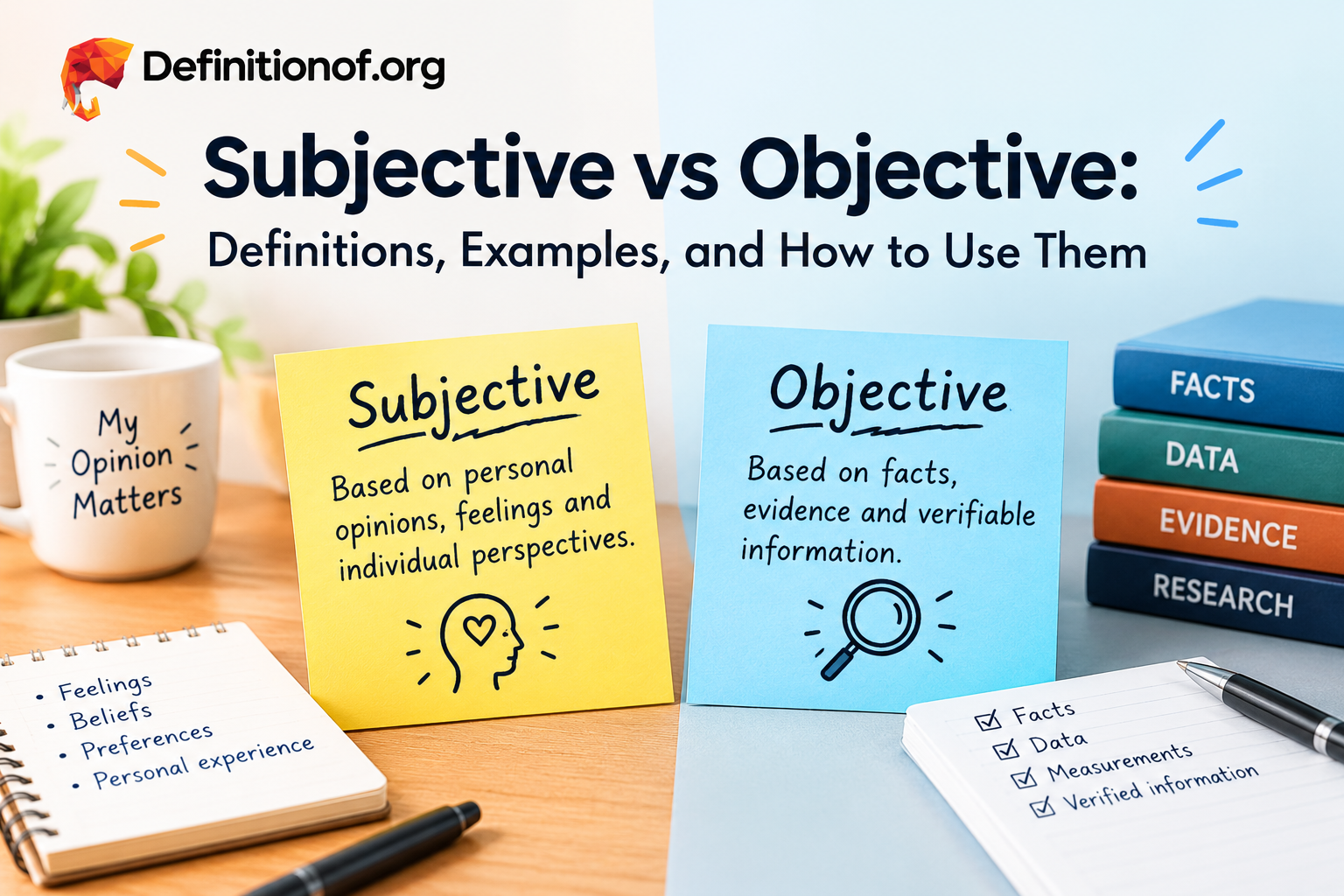
Subjective and objective describe two different ways of expressing information, opinions, and judgments. Subjective refers to personal opinions, feelings, and individual perspectives, while objective refers to facts, evidence, and information that can be verified independently. Understanding subjective vs objective helps readers distinguish personal beliefs from factual statements in conversations, academic writing, journalism, research, and everyday communication.
The difference between subjective and objective appears in writing, decision-making, observations, and descriptions. Subjective statements reflect personal experiences or interpretations, whereas objective statements rely on measurable information and evidence. Learning both meanings, their examples, and their correct sentence usage makes communication clearer and more accurate.
Quick summary
The main difference between subjective and objective is the source of information.
- Subjective: Based on personal opinions, emotions, preferences, or individual experiences.
- Objective: Based on facts, evidence, observations, or information that can be independently verified.
| Comparison | Subjective | Objective |
|---|---|---|
| Meaning | Based on personal opinions | Based on facts and evidence |
| Perspective | Personal | Independent of personal opinion |
| Information | Feelings and interpretations | Verifiable information |
| Evidence | May rely on personal experience | Requires supporting facts or evidence |
| Bias | Can contain personal bias | Aims to minimize personal bias |
| Example | This movie is excellent. | The movie runs for 120 minutes. |
| Common use | Reviews, opinions, personal essays | Research, reports, factual writing |
For example, saying “The weather is beautiful” is subjective because beauty depends on personal preference. Saying “The temperature is 25°C” is objective because the temperature can be measured.
Subjective definition
Subjective means based on personal feelings, opinions, preferences, experiences, or interpretations rather than facts that everyone can independently verify.
A subjective statement reflects how an individual thinks or feels about something. Different people can have different subjective opinions about the same subject without either person necessarily being wrong.
Examples of subjective statements include:
- Chocolate ice cream tastes better than vanilla.
- Summer is the most enjoyable season.
- This painting is beautiful.
- Reading fiction is more interesting than watching television.
- The restaurant serves the best pizza in town.
These statements express personal preferences. They cannot be established as universally true through measurement alone.
Subjective writing
Subjective writing expresses the writer’s personal opinions, feelings, experiences, or interpretations of a topic.
Writers use subjective language to communicate personal perspectives and emotional responses. Subjective writing commonly appears in reviews, opinion articles, personal essays, diaries, blogs, and creative writing.
Five common characteristics of subjective writing include:
- Personal opinions: The writer expresses individual beliefs and judgments.
- Emotional language: The writing communicates feelings such as happiness, sadness, excitement, or disappointment.
- Personal experiences: The writer describes events from an individual perspective.
- Interpretations: The writer explains how they understand or perceive a situation.
- Preferences: The writer identifies personal likes, dislikes, and choices.
Examples of subjective writing:
- I believe online education is more convenient than traditional classroom learning.
- The new smartphone has an excellent design.
- In my opinion, this book is more interesting than the previous one.
- The city looks beautiful during the rainy season.
Subjective writing is useful when the purpose is to express opinions, share experiences, review products, or communicate personal perspectives.
Objective definition
Objective means based on facts, evidence, observations, or information that can be verified independently of personal feelings and opinions.
An objective statement presents information without allowing personal preferences or emotions to determine the facts. Objective information can often be checked through measurements, records, research, or reliable observations.
Examples of objective statements include:
- The Earth revolves around the Sun.
- Water freezes at 0°C under standard atmospheric pressure.
- The book contains 250 pages.
- The meeting begins at 10:00 AM.
- The company was established in 2015.
These statements describe information that can be checked or supported through evidence.
Objective writing
Objective writing presents information using facts, evidence, and clear descriptions rather than personal opinions or emotional judgments.
Writers use objective language in academic papers, scientific reports, news reporting, research documents, business reports, and technical explanations.
Five common characteristics of objective writing include:
- Factual information: The writing presents information that can be checked.
- Evidence-based statements: Claims rely on supporting data, research, or observations.
- Neutral language: The writer avoids unnecessary emotional or judgmental expressions.
- Clear descriptions: Information is presented in a direct and understandable way.
- Verifiable details: Readers can examine the information and evaluate its accuracy.
Examples of objective writing:
- The survey included 500 participants.
- The product weighs 1.5 kilograms.
- The research was conducted over six months.
- The company reported a 12% increase in revenue.
- The library opens at 9:00 AM.
Objective writing helps readers evaluate information without relying on the writer’s personal preferences.
Objective: Other definitions
The word objective has several meanings depending on the context in which it appears.
1. Objective as a goal
An objective can mean a specific goal or result that someone wants to achieve.
Example: The main objective of the project is to improve customer satisfaction.
2. Objective as a lens
In photography, microscopy, and optical instruments, an objective lens is the lens positioned closest to the object being viewed.
Example: The microscope uses a 40x objective lens to examine small structures.
3. Objective as an adjective
Objective describes information or judgment based on facts rather than personal feelings.
Example: The journalist provided an objective account of the event.
4. Objective in education
An educational objective describes a specific learning outcome that students are expected to achieve.
Example: The lesson objective is to explain the differences between subjective and objective statements.
Subjective vs objective examples
Subjective and objective statements describe information from different perspectives. The following examples show how the same topic can be expressed in subjective and objective ways.
| Topic | Subjective example | Objective example |
|---|---|---|
| Weather | Today is a beautiful day. | The temperature is 28°C. |
| Food | This restaurant serves delicious food. | The restaurant serves 15 dishes. |
| Education | Mathematics is a difficult subject. | Mathematics is a required subject in the course. |
| Movies | This is the best movie of the year. | The movie was released in 2025. |
| Sports | Football is the most exciting sport. | A football match lasts 90 minutes in regular time. |
| Books | This is an inspiring book. | The book contains 300 pages. |
| Technology | This smartphone has an attractive design. | The smartphone has a 6.5-inch display. |
| Travel | Paris is the most beautiful city. | Paris is the capital of France. |
| Music | Classical music is relaxing. | Classical music includes compositions from different historical periods. |
| Shopping | This is an expensive product. | The product costs $500. |
The subjective examples contain personal judgments or preferences. The objective examples provide descriptions or information that can be checked.
A statement can contain both subjective and objective information. For example, “The smartphone costs $500, and it is an excellent purchase” contains an objective price and a subjective opinion about its value.
How to use subjective vs. objective
Use subjective when describing personal opinions, emotions, preferences, or interpretations. Use objective when presenting facts, evidence, measurements, or information that readers can independently verify.
The correct word depends on the purpose of the sentence.
Use subjective in these situations:
- Expressing personal opinions about a topic.
- Describing emotional experiences.
- Writing product or movie reviews.
- Sharing personal preferences.
- Explaining individual interpretations.
Use objective in these situations:
- Presenting scientific findings.
- Writing academic research.
- Reporting measurable results.
- Describing historical events using evidence.
- Preparing factual business documents.
Choosing the correct word helps readers understand whether a statement represents a personal perspective or verifiable information.
Examples of subjective and objective used in a sentence
Here are 10 sentences showing how subjective and objective work in everyday communication.
Subjective sentences:
- My favorite subject in school is English.
- This restaurant has the most delicious desserts.
- I think the new movie is entertaining.
- The blue dress looks more attractive than the red one.
- In my opinion, working from home is more comfortable.
Objective sentences:
- English is one of the subjects offered in the school curriculum.
- The restaurant serves eight different desserts.
- The movie was released in October 2025.
- The blue dress costs $40, while the red dress costs $35.
- The company allows employees to work remotely three days per week.
These examples show that subjective sentences communicate individual judgments, while objective sentences communicate specific information.
Tips to remember the difference
Remembering the difference between subjective and objective becomes easier by identifying whether a statement expresses a personal perspective or presents verifiable information.
Here are five useful tips:
- Look for personal opinions: Words such as “I think,” “I believe,” and “in my opinion” often indicate subjective statements.
- Identify emotional language: Words such as “beautiful,” “boring,” “amazing,” and “terrible” can signal subjective judgments.
- Look for measurable information: Numbers, dates, percentages, and measurements often support objective statements.
- Check the evidence: Ask whether the statement can be verified through reliable information or observations.
- Identify the purpose: Personal reviews usually contain subjective language, while scientific reports generally prioritize objective information.
A simple memory tip is that subjective connects with personal perspectives, while objective connects with observable or verifiable information.
Frequently asked questions about subjective vs objective
1. What is the main difference between subjective and objective?
The main difference is that subjective refers to personal opinions, feelings, and experiences, while objective refers to facts, evidence, and information that can be independently verified.
2. Is subjective positive or negative?
Subjective is neither positive nor negative. It describes information based on personal opinions, feelings, or interpretations. A subjective statement can express a positive, negative, or neutral opinion.
3. Can something be both subjective and objective?
Yes, a statement or situation can contain both subjective and objective elements. For example, “The laptop costs $1,000 and is an excellent device” includes an objective price and a subjective opinion about the laptop.
4. Is objective the same as unbiased?
Objective and unbiased are closely related, but they are not exactly the same. Objective means based on facts and evidence, while unbiased means free from unfair preferences or prejudice. Objective writing aims to minimize bias, but factual information can still be selected or presented in a biased way.