
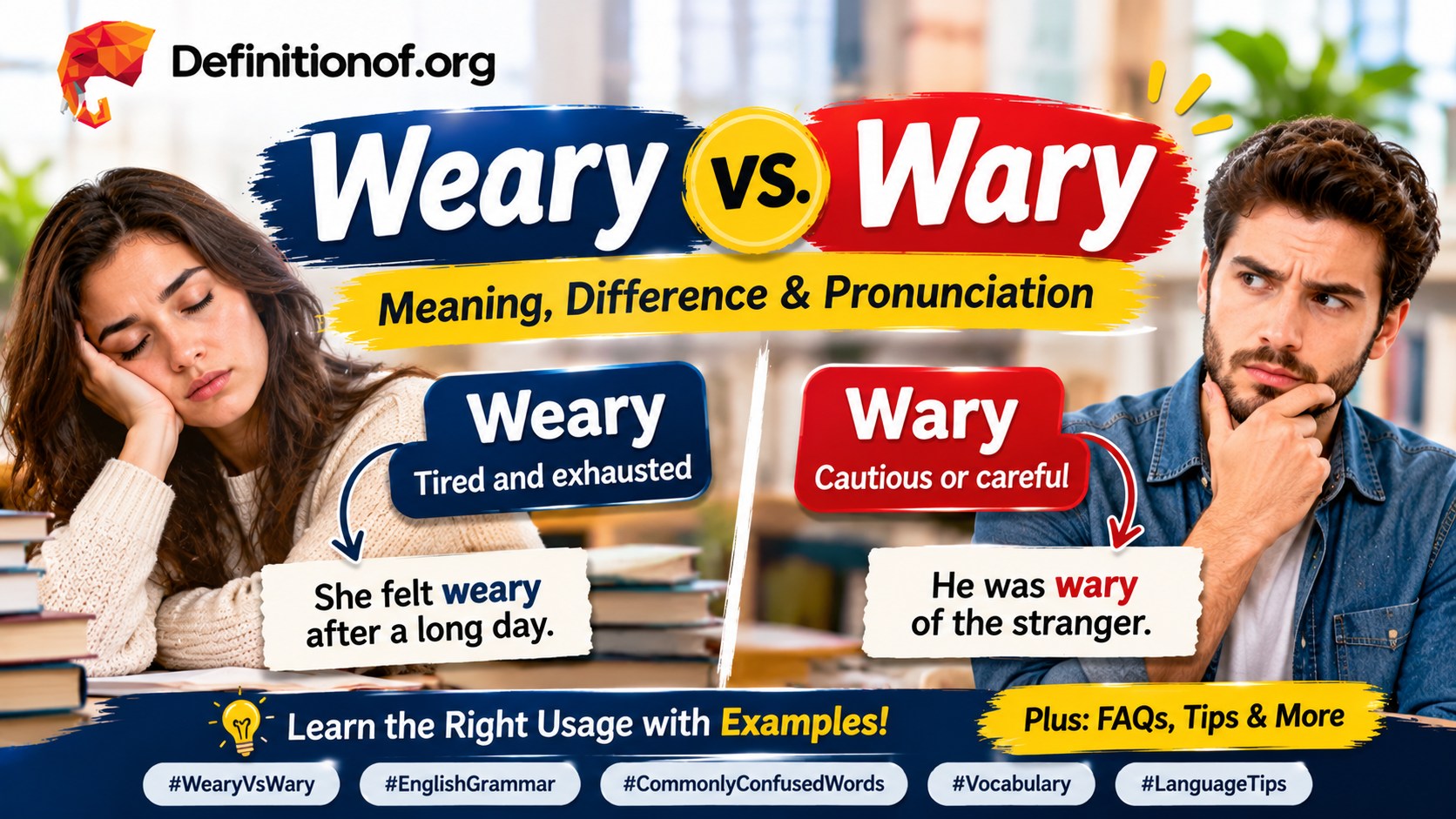
Weary vs Wary: Meaning, Difference & Pronunciation
Weary means tired or exhausted, while wary means cautious or alert because something may be dangerous or unreliable. Both words are adjectives, but they describe different feelings and situations.
For example, a person who has worked all day may feel weary. A person who checks a suspicious email before opening it is wary.
The main difference between weary and wary involves physical or mental tiredness versus caution. Their pronunciation, sentence patterns, and meanings can help you choose the correct word.
Wary Meaning
Wary is an adjective that means careful, cautious, or alert because someone senses a possible risk, problem, or danger.
Pronunciation: /ˈwer.i/ (WAIR-ee)
A wary person does not trust a situation completely and takes care before acting. The word commonly appears with the preposition of, as in wary of strangers or wary of making promises.
Examples:
- The residents were wary of strangers entering their neighborhood.
- She remained wary of online offers that promised easy money.
- Investors are wary of companies with unclear financial records.
- The dog became wary when an unfamiliar person approached.
Synonyms: cautious, careful, alert, watchful, guarded, suspicious, distrustful.
Antonyms: trusting, confident, careless, reckless, unwary.
Weary Meaning
Weary is an adjective that means physically or mentally tired, especially after doing something for a long time. It can describe exhaustion, boredom, or a loss of patience.
Pronunciation: /ˈwɪə.ri/ (WEER-ee)
A person may feel weary after hard work, a long journey, repeated problems, or a demanding experience. The word can describe both physical fatigue and emotional exhaustion.
Examples:
- The workers felt weary after completing a long shift.
- She gave a weary smile after a difficult day.
- The travelers were weary from walking for several hours.
- He grew weary of listening to the same complaints.
Synonyms: tired, exhausted, fatigued, drained, worn-out, sluggish, spent.
Antonyms: energetic, refreshed, rested, active, lively.
wary or weary: Meaning & Key Differences
Wary describes caution, while weary describes tiredness. Use wary when someone is careful about a possible risk. Use weary when someone feels physically or mentally exhausted.
| Difference | Wary | Weary |
|---|---|---|
| Part of speech | Adjective | Adjective |
| Meaning | Cautious or alert | Tired or exhausted |
| Main idea | Possible danger or risk | Lack of energy or patience |
| Common phrase | Wary of danger | Weary from work |
| Pronunciation | /ˈwer.i/ | /ˈwɪə.ri/ |
| Example | She is wary of strangers. | She is weary after work. |
Easy way to remember
- Wary = Watchful: Both words begin with W and relate to being alert.
- Weary = Worn out: Both expressions describe tiredness.
Compare these sentences:
- The traveler was wary of taking an unfamiliar road at night. (The traveler felt cautious.)
- The traveler was weary after driving for ten hours. (The traveler felt tired.)
The two words are not interchangeable. Replacing one with the other changes the meaning of the sentence.
Examples of wary
The word wary is used when a person, animal, or group acts carefully because of a possible threat, risk, or uncertain situation.
Examples include:
- The customer was wary of buying a product without reading its reviews.
- Parents are often wary of websites that collect children’s personal information.
- The hikers were wary of the wild animals near the campsite.
- She was wary of accepting an offer that seemed too good to be true.
- The company remained wary of investing in an unstable market.
- The horse became wary when it heard a sudden noise.
- He was wary of sharing confidential information online.
How to use wary in a sentence
To use wary correctly, describe a person or group that is cautious about a person, action, situation, or possible risk.
Common sentence patterns include:
- Wary of + noun: She is wary of strangers.
- Wary of + verb ending in -ing: He is wary of making quick decisions.
- Remain wary: Investors should remain wary during uncertain market conditions.
- Become wary: The child became wary of the unfamiliar dog.
Avoid using wary to describe ordinary physical tiredness. Use weary for that meaning.
Examples of weary
The word weary describes physical fatigue, mental exhaustion, or frustration caused by something that continues for a long time.
Examples include:
- The nurse felt weary after working a twelve-hour shift.
- The students looked weary after completing their final examinations.
- She was weary from carrying heavy bags across the city.
- The long journey left the passengers weary.
- He gave a weary sigh after another unsuccessful attempt.
- The team grew weary of repeated delays.
- The hikers were weary but pleased to reach the campsite.
How to use weary in a sentence
To use weary correctly, describe someone who feels tired, drained, or fed up after effort or repeated experiences.
Common sentence patterns include:
- Weary after + activity: She felt weary after the long meeting.
- Weary from + activity: He was weary from working all night.
- Weary of + noun: They grew weary of the constant noise.
- A weary + noun: She gave a weary smile.
Use weary of when describing boredom or frustration with something repeated. Use weary from when identifying the activity that caused tiredness.
Frequently asked questions about weary vs wary
1. What is the main difference between weary and wary?
Weary means tired or exhausted, while wary means cautious or watchful. A weary person needs rest, while a wary person takes care because of a possible risk.
2. Are weary and wary pronounced the same?
No. Weary is pronounced /ˈwɪə.ri/ (WEER-ee), while wary is pronounced /ˈwer.i/ (WAIR-ee). Their vowel sounds differ.
3. Is it wary of or weary of?
Both expressions are correct, but they have different meanings. Wary of means cautious about something, while weary of means tired of or frustrated with something.
Examples:
- She is wary of strangers. (She does not trust them easily.)
- She is weary of the constant arguments. (She is tired of them.)
4. Can weary describe emotional tiredness?
Yes. Weary can describe physical fatigue, mental exhaustion, and emotional tiredness. For example, a person may feel weary after dealing with repeated stress or difficult situations.
5. What are the synonyms of wary and weary?
Common synonyms of wary include cautious, careful, alert, watchful, and guarded. Common synonyms of weary include tired, exhausted, fatigued, drained, and worn-out.
Commonly Confused
English has many word pairs that look or sound similar but have different meanings. Learning the differences helps prevent spelling and grammar mistakes.
What’s the difference between ‘fascism’ and ‘socialism’?
Fascism and socialism are different political ideologies. Fascism is an authoritarian political ideology associated with dictatorial leadership, extreme nationalism, and the suppression of political opposition. Socialism is a political and economic tradition that supports social or public ownership, control, or regulation of important resources and industries.
The terms are not interchangeable:
- Fascism: Associated with authoritarian government and extreme nationalism.
- Socialism: Focuses on social ownership or control of economic resources and reducing economic inequality.
7 Pairs of Commonly Confused Words
| Word pair | Meaning difference | Example |
|---|---|---|
| Accept / Except | Accept means receive; except means excluding. | I accept every option except the last one. |
| Affect / Effect | Affect is usually a verb; effect is usually a noun. | The weather can affect the result. |
| Advice / Advise | Advice is a noun; advise is a verb. | My teacher gave me useful advice. |
| Compliment / Complement | Compliment means praise; complement means complete or go well with. | The colors complement each other. |
| Principal / Principle | Principal can mean a school leader or main person; principle means a rule or belief. | Honesty is an important principle. |
| Stationary / Stationery | Stationary means not moving; stationery means writing materials. | The car remained stationary near the stationery shop. |
| Then / Than | Then refers to time or sequence; than introduces a comparison. | She is taller than her brother. |
‘Capitol’ or ‘Capital’?
Capital can mean a country’s main city, financial resources, or an uppercase letter. Capitol refers to a building where a legislative body meets.
Examples:
- New Delhi is the capital of India.
- The United States Congress meets in the Capitol in Washington, D.C.
- The business needs more capital to expand.
- Write the first letter of the sentence as a capital letter.
‘Demur’ and ‘Demure’: Not to be Confused
Demur is a verb meaning to object or express hesitation. Demure is an adjective describing someone who is quiet, modest, or reserved.
Examples:
- The employee did not demur when the manager explained the decision.
- She wore a demure dress to the formal event.
‘Lose’ or ‘loose’?
Lose is a verb meaning to misplace something or fail to win. Loose is an adjective meaning not tight or firmly fixed.
Examples:
- Do not lose your phone.
- These shoes are too loose.
- Our team does not want to lose the final match.
- The handle became loose after repeated use.
Grammar & Usage
Grammar and usage explain how words function in sentences. These topics provide further reading for people who want to improve spelling, vocabulary, and writing.
‘That’ vs. ‘Which’
That commonly introduces a restrictive clause, which gives information needed to identify a noun. Which often introduces a nonrestrictive clause that adds extra information.
Examples:
- The book that I borrowed is on the table.
- The book, which I borrowed yesterday, is on the table.
Punctuation and usage conventions can vary by style guide and English variety.
More Commonly Mispronounced Words
Some English words are difficult to pronounce because their spelling does not clearly represent their sounds.
Examples include:
- Mischievous: MIS-chuh-vus.
- February: FEB-roo-er-ee or FEB-yoo-er-ee, depending on the speaker and variety.
- Library: LYE-brer-ee.
- Espresso: Es-PRES-oh.
- Pronunciation: Pro-nun-see-AY-shun.
Use a trusted dictionary’s audio feature to check unfamiliar pronunciations.
31 Useful Rhetorical Devices
Rhetorical devices are language techniques used to create emphasis, express ideas, and influence an audience. Here are 31 examples:
- Alliteration: Repetition of initial consonant sounds.
- Anaphora: Repetition at the beginning of successive clauses.
- Antithesis: Contrast between opposing ideas.
- Apostrophe: Direct address to an absent person or abstract idea.
- Assonance: Repetition of vowel sounds.
- Chiasmus: Reversal of grammatical structure in related phrases.
- Climax: Arrangement of ideas in increasing importance.
- Consonance: Repetition of consonant sounds.
- Euphemism: A mild expression replacing a harsh one.
- Hyperbole: Deliberate exaggeration.
- Irony: A contrast between expectation and reality.
- Litotes: Understatement expressed through a negative.
- Metaphor: A direct comparison between unlike things.
- Metonymy: Using a related term to represent something.
- Onomatopoeia: A word that imitates a sound.
- Oxymoron: Two apparently contradictory terms used together.
- Paradox: A statement that appears contradictory but may express a truth.
- Parallelism: Repetition of a similar grammatical structure.
- Personification: Giving human qualities to nonhuman things.
- Polysyndeton: Repeated use of conjunctions.
- Rhetorical question: A question asked for effect rather than an answer.
- Sarcasm: A mocking or cutting form of expression.
- Simile: A comparison using like or as.
- Synecdoche: Using a part to represent a whole or vice versa.
- Understatement: Presenting something as less significant than it is.
- Zeugma: One word governing two other words in different senses.
- Allusion: An indirect reference to a known person, event, or work.
- Asyndeton: Omitting conjunctions between related words or phrases.
- Aporia: Expressing doubt or uncertainty.
- Epistrophe: Repetition at the ends of successive clauses.
- Hypophora: Asking a question and then answering it.
How to Use ‘Who’ vs. ‘Whom’
Who functions as the subject of a verb. Whom functions as the object of a verb or preposition.
Examples:
- Who called you?
- Whom did you invite?
- Who is responsible for the project?
- To whom should I send the letter?
A quick test is to replace the word with he or him. Use who when he fits, and whom when him fits.
Merriam-Webster’s Great Big List of Words You Love to Hate
Some English words attract strong reactions because of their sound, meaning, spelling, or frequent misuse. Examples include:
- Irregardless: A nonstandard variant of regardless that appears in informal usage.
- Moist: An adjective meaning slightly wet.
- Literally: Means exactly or in a strict sense; it is also used informally for emphasis.
- Utilize: A verb meaning to use something for a purpose.
- Supposably: A word meaning supposedly or as may be supposed, though it is less common.
A word’s popularity or reputation does not determine whether it is grammatically accepted. Check a dictionary for its current usage.
Wordplay
Wordplay uses the sounds, meanings, and spellings of words to create humor or more than one interpretation. These vocabulary topics offer further reading.
The History Behind 8 Halloween Words
Halloween vocabulary has roots in older customs, folklore, religious observances, and seasonal traditions.
- Halloween: Derived from All Hallows’ Eve, the evening before All Saints’ Day.
- Witch: A word historically used for a person believed to practise magic.
- Ghost: The spirit of a dead person.
- Goblin: A mythical creature often described as mischievous.
- Vampire: A mythical being believed to feed on blood.
- Monster: A creature regarded as frightening or unnatural.
- Jack-o’-lantern: A carved pumpkin or other vegetable containing a light.
- Trick-or-treat: A Halloween custom in which children ask for sweets or threaten a playful trick.
11 Words Used by Edgar Allan Poe
Edgar Allan Poe used vivid vocabulary to create suspense, mystery, and dark atmosphere in his poetry and stories. These 11 words illustrate literary language associated with his writing:
- Nevermore: Never again.
- Raven: A large black bird.
- Pallid: Pale or lacking color.
- Ghastly: Extremely frightening or unpleasant.
- Melancholy: A feeling of deep sadness.
- Quoth: An old-fashioned word meaning said.
- Tremulous: Shaking or trembling.
- Dreary: Gloomy or depressing.
- Obscure: Unclear, hidden, or difficult to understand.
- Mournful: Expressing sadness or grief.
- Eerie: Strange and frightening.
7 Words for Old-Timey Vehicles
Older forms of transport have names that may be unfamiliar to modern readers. Seven examples are:
- Carriage: A wheeled vehicle pulled by horses.
- Brougham: A closed, horse-drawn carriage.
- Hansom: A two-wheeled horse-drawn carriage.
- Landau: A carriage with a convertible top.
- Barouche: A four-wheeled carriage with a folding hood.
- Buggy: A light horse-drawn vehicle.
- Stagecoach: A large carriage used to carry passengers along scheduled routes.
The Longest Long Words List
Long English words often come from science, medicine, and technical terminology. Examples include:
- Pneumonoultramicroscopicsilicovolcanoconiosis: A term for a lung disease associated with inhaling very fine silica or quartz dust.
- Antidisestablishmentarianism: Opposition to the disestablishment of a state church.
- Floccinaucinihilipilification: The act of describing something as worthless.
- Hippopotomonstrosesquipedaliophobia: A humorous term for the fear of long words.
Long words are not always useful in everyday writing. Choose vocabulary that makes the meaning clear.
9 Words That Sound Like Insults But Aren’t
Some words may sound negative but have neutral or specific dictionary meanings. Context determines how readers interpret them.
- Pusillanimous: Lacking courage.
- Cretaceous: Relating to a geological period.
- Nincompoop: An informal word for a foolish person.
- Lugubrious: Looking or sounding mournful.
- Churlish: Rude or bad-tempered.
- Mediocre: Of average or ordinary quality.
- Pedantic: Overly concerned with minor rules or details.
- Obtuse: Slow to understand or not sharp in shape or angle.
- Maladroit: Clumsy or lacking skill.
Games & Quizzes
Vocabulary games and quizzes help learners practise spelling, definitions, pronunciation, and word usage. Useful activities include:
- Meaning quizzes: Choose the correct definition of a word.
- Spelling quizzes: Identify the correctly spelled word.
- Synonym challenges: Find a word with a similar meaning.
- Antonym quizzes: Select a word with the opposite meaning.
- Sentence completion: Choose the word that fits the context.
- Pronunciation practice: Listen to a word and identify its pronunciation.
A weary vs. wary quiz can ask learners to select the correct word in sentences about tiredness and caution.
Popular
Popular vocabulary resources help readers explore definitions, spelling, pronunciation, grammar, and word history. Commonly confused word guides are useful for learners who want to choose the correct word in everyday writing.
Word of the Day
A Word of the Day feature introduces one selected word with its pronunciation, part of speech, definition, and an example sentence. Daily vocabulary practice helps learners become familiar with new words and their uses.
Others also liked
Readers exploring weary vs. wary may find these word-comparison guides useful:
Bear vs Bare | Difference, Meaning & Examples
Bear can mean to carry, support, or endure, and it can refer to a large mammal. Bare means uncovered or without something.
Among vs Amongst | Definition & Examples
Among and amongst both mean surrounded by or included in a group. Among is more common in modern American English, while amongst appears more often in British English.
Aid vs Aide | Meaning, Difference & Examples
Aid means help or assistance and can function as a noun or verb. Aide is a noun referring to a person who provides assistance.
Conclusion
The difference between weary vs. wary depends on whether a sentence describes tiredness or caution. Weary means physically or mentally exhausted, while wary means careful or alert about a possible risk. Use the pronunciation, meaning, and sentence examples to choose the correct word and avoid confusing the two.