
What Do AM and PM Stand For?
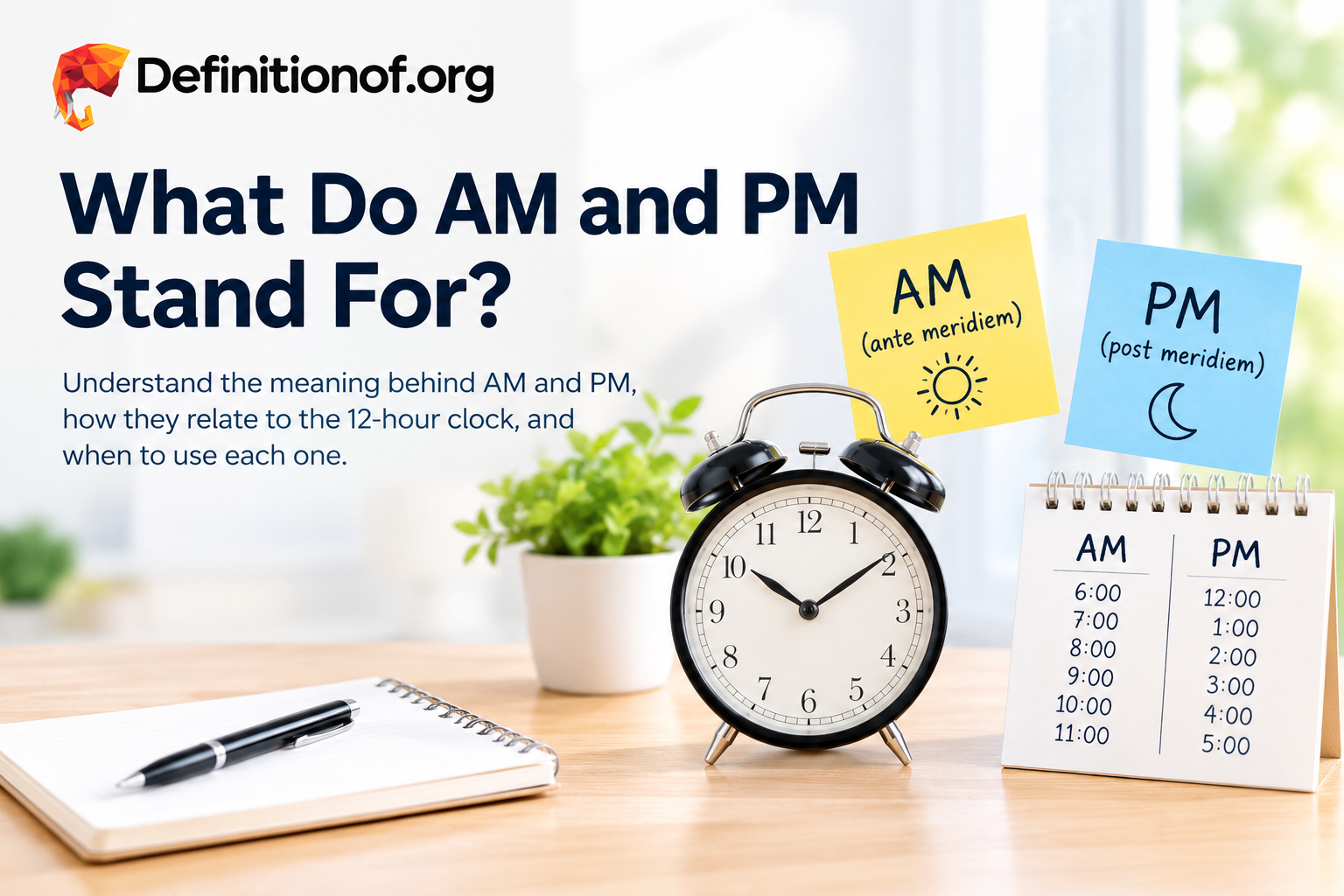
AM and PM are abbreviations used in the 12-hour clock system to distinguish between morning and afternoon or evening hours. AM stands for Ante Meridiem, meaning before midday, while PM stands for Post Meridiem, meaning after midday. Both terms come from Latin and divide a 24-hour day into two 12-hour periods.
The 12-hour clock uses AM for the hours from midnight until just before noon and PM for the hours from noon until just before midnight. Understanding AM and PM helps people read clock times, schedule appointments, arrange meetings, and distinguish daytime hours from nighttime hours. Midnight and noon are the two points that require special attention because both are written as 12:00.
Two 12-Hour Periods
The 12-hour clock divides a 24-hour day into two periods: AM and PM. Each period contains 12 hours, beginning at 12:00 and ending at 11:59.
AM (Ante Meridiem) refers to the period before midday, covering midnight through the late morning.
Examples of AM times include:
- 12:00 AM – Midnight
- 1:00 AM – One hour after midnight
- 6:00 AM – Early morning
- 9:00 AM – Morning
- 11:00 AM – Late morning
PM (Post Meridiem) refers to the period after midday, covering afternoon and evening hours until midnight.
Examples of PM times include:
- 12:00 PM – Noon
- 1:00 PM – Early afternoon
- 3:00 PM – Afternoon
- 6:00 PM – Evening
- 10:00 PM – Night
The main difference between AM and PM is their position in relation to midday. AM identifies times before noon, while PM identifies times after noon.
Midnight and Noon: AM or PM?
Midnight is 12:00 AM, and noon is 12:00 PM. These two times mark the beginning of the AM and PM periods, respectively.
The distinction is important because the number 12 can cause confusion when reading a 12-hour clock.
| Time | Meaning |
|---|---|
| 12:00 AM | Midnight |
| 12:01 AM | One minute after midnight |
| 6:00 AM | Morning |
| 11:59 AM | One minute before noon |
| 12:00 PM | Noon |
| 12:01 PM | One minute after noon |
| 6:00 PM | Evening |
| 11:59 PM | One minute before midnight |
A useful way to remember the difference is that 12:00 AM starts a new calendar day, while 12:00 PM represents the middle of the day.
Midnight Confusion: Which Date Is It?
Midnight can create confusion when scheduling appointments, flights, travel plans, and other events because midnight marks the transition from one calendar date to another.
12:00 AM belongs to the beginning of the date shown on the calendar. For example, 12:00 AM on Friday means the very beginning of Friday, immediately after Thursday ends.
Consider these examples:
- Thursday, 11:59 PM – The final minute of Thursday.
- Friday, 12:00 AM – The beginning of Friday.
- Friday, 12:01 AM – One minute into Friday.
- Friday, 12:00 PM – Friday at noon.
When arranging appointments or booking travel, writing the full date and using a 24-hour time format can prevent misunderstandings. For example, 00:00 on Friday clearly identifies the beginning of Friday.
Converting Times
Converting between the 12-hour and 24-hour clock systems requires identifying whether a time belongs to the AM or PM period.
The 24-hour clock uses numbers from 00:00 to 23:59 and does not require AM or PM.
Converting from 12-Hour to 24-Hour
To convert a 12-hour time into a 24-hour time, follow these rules:
- For AM times from 1:00 AM to 11:59 AM: Keep the hour unchanged.
- For 12:00 AM: Change the hour to 00.
- For 12:00 PM: Keep the hour as 12.
- For PM times from 1:00 PM to 11:59 PM: Add 12 to the hour.
Examples:
| 12-Hour Time | 24-Hour Time |
|---|---|
| 12:00 AM | 00:00 |
| 2:00 AM | 02:00 |
| 7:30 AM | 07:30 |
| 11:45 AM | 11:45 |
| 12:00 PM | 12:00 |
| 2:00 PM | 14:00 |
| 5:30 PM | 17:30 |
| 9:45 PM | 21:45 |
| 11:00 PM | 23:00 |
For example, 4:30 PM becomes 16:30 because 4 + 12 = 16.
Converting from 24-Hour to 12-Hour
To convert a 24-hour time into a 12-hour time, identify the hour and apply the following rules:
- For 00:00: Convert the time to 12:00 AM.
- For hours from 01 to 11: Keep the hour and add AM.
- For 12:00: Keep the hour and add PM.
- For hours from 13 to 23: Subtract 12 and add PM.
Examples:
| 24-Hour Time | 12-Hour Time |
|---|---|
| 00:00 | 12:00 AM |
| 03:00 | 3:00 AM |
| 08:30 | 8:30 AM |
| 11:45 | 11:45 AM |
| 12:00 | 12:00 PM |
| 14:00 | 2:00 PM |
| 17:30 | 5:30 PM |
| 20:45 | 8:45 PM |
| 23:00 | 11:00 PM |
For example, 18:30 becomes 6:30 PM because 18 − 12 = 6.
Where Is the 12-Hour Format Used?
The 12-hour clock format is commonly used in everyday communication in countries such as the United States, Canada, Australia, New Zealand, India, and the Philippines.
People use AM and PM when discussing daily schedules, setting alarms, arranging meetings, planning activities, and communicating appointment times.
The 12-hour format appears in several everyday applications:
- Digital clocks: Many household clocks and electronic devices display time using AM and PM.
- Mobile phones: Smartphone clock settings often allow users to choose between 12-hour and 24-hour formats.
- Appointments: Businesses and individuals use AM and PM to communicate meeting and appointment times.
- Transportation: Travel schedules may use either the 12-hour or 24-hour format, depending on the country and service.
- Daily schedules: People use AM and PM to distinguish morning activities from afternoon and evening activities.
The 24-hour format is widely used in aviation, military operations, healthcare, transportation, and international communication because it reduces confusion between morning and evening times.
Why Does the Day Have 24 Hours?
A standard day has 24 hours because the modern timekeeping system divides the day into 24 equal hourly periods. This system developed through ancient timekeeping practices and later astronomical measurements.
Ancient Egyptians divided daylight and nighttime into 12 parts each, creating a system of 24 divisions. The length of these early divisions varied with seasonal daylight and nighttime changes. Later astronomical and mathematical traditions helped establish more consistent time measurement.
Today, a mean solar day is approximately 24 hours, based on Earth’s rotation relative to the Sun.
Coordinated Universal Time (UTC)
Coordinated Universal Time (UTC) is the primary international time standard used to coordinate clocks and timekeeping around the world.
UTC provides a common reference for international travel, aviation, telecommunications, scientific research, and computer systems.
Countries use different time zones based on their geographical locations and UTC offsets. For example:
- India uses Indian Standard Time (IST), which is UTC+05:30.
- The United Kingdom uses UTC during standard time and UTC+01:00 during British Summer Time.
- Japan uses Japan Standard Time (JST), which is UTC+09:00.
- New York uses UTC−05:00 during standard time and UTC−04:00 during daylight saving time.
UTC does not use AM or PM. It commonly uses the 24-hour clock format to communicate time without ambiguity.
World Clock
A world clock displays the current local time in different cities and time zones. It helps people compare international time differences and coordinate activities across countries.
For example, someone arranging an online meeting between India, London, and New York needs to consider the local time in each location.
World clocks are useful for:
- Checking the current time in international cities.
- Comparing time differences between countries.
- Scheduling international business meetings.
- Planning overseas travel.
- Coordinating online events and remote work.
A world clock makes international scheduling easier by displaying local times in different locations.
Frequently Asked Questions
1. What do AM and PM stand for in full?
AM stands for Ante Meridiem, a Latin phrase meaning before midday. PM stands for Post Meridiem, meaning after midday. Both abbreviations are used in the 12-hour clock system.
2. Is 12 AM midnight or noon?
12 AM means midnight, the beginning of a new calendar day. 12 PM means noon, the middle of the day.
3. Is 12 PM morning or afternoon?
12 PM represents noon. It marks the transition from morning to afternoon, so it is neither a morning hour nor an afternoon hour in the strict sense.
4. What is the difference between AM and PM?
AM represents the hours from midnight until just before noon, while PM represents the hours from noon until just before midnight. The 12-hour clock uses these abbreviations to distinguish the two daily periods.